
How to Sell a House As-Is for Cash in Tucson, AZ (2026)

Selling as-is for cash in Tucson means a buyer takes your home in its current condition and prices it below repaired retail value after repairs, holding costs, and profit margin. A prepared transaction can target about 7–30 days, but only after ownership, title, mortgage payoff, and available funds are clear.
Updated October 2026.

What Does an As-Is Cash Sale in Tucson Mean
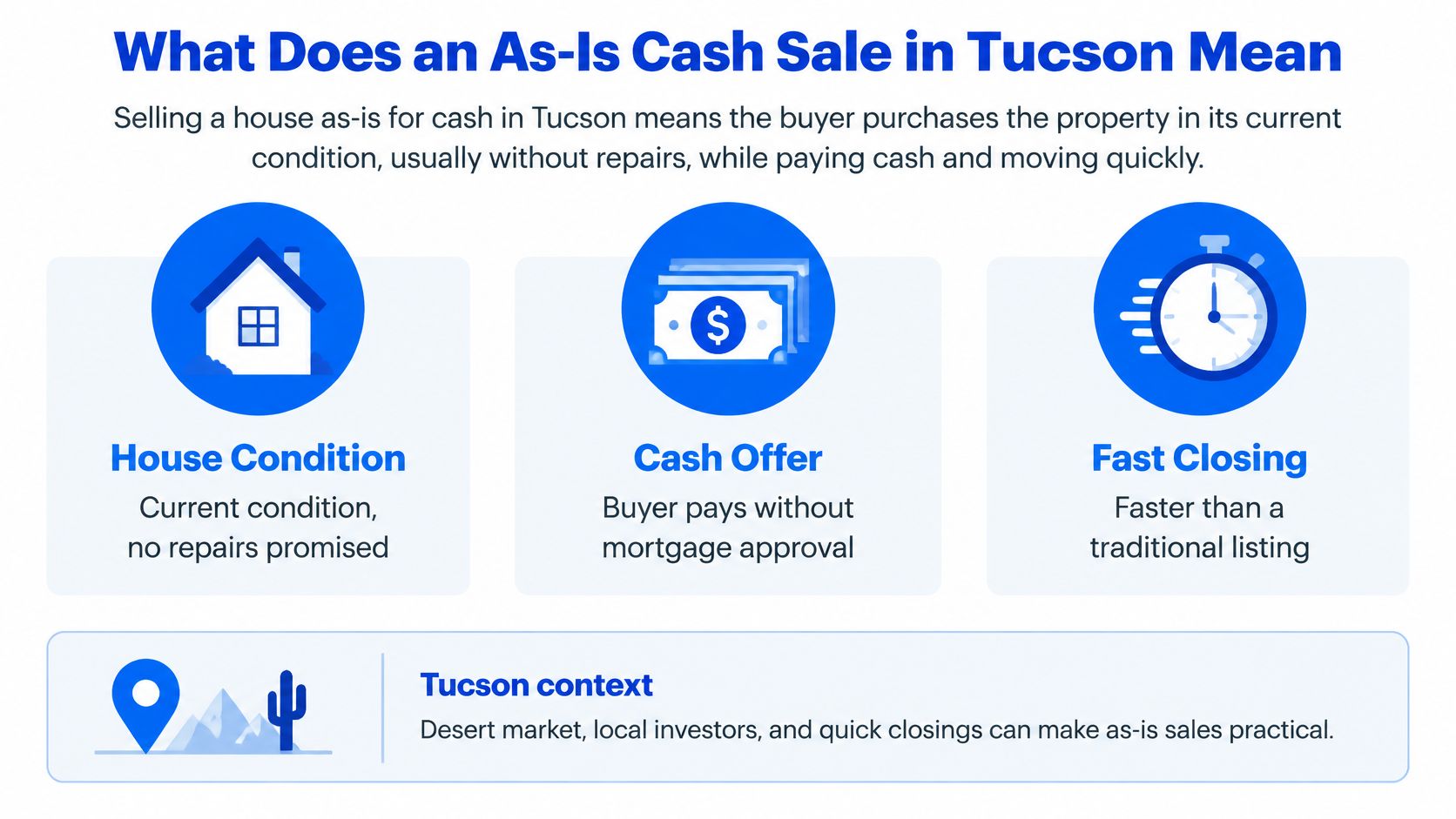
An as-is cash sale sets the home's condition and the buyer's funding method in separate parts of the deal. You agree to sell without promising repairs, while the contract spells out whether the buyer can inspect, cancel, change the price, or assign the agreement to someone else.
What does the local market tell you?
Tucson sits within Pima County, but a citywide median cannot price every home. A house in Central Tucson may need different comparable sales and condition adjustments than one in the Tucson Mountains, Tortolita, Catalina Foothills, or Rita Ranch.
October 2026 reports offered different snapshots of the market. Realtor.com reported a $355,000 median listing price and 58-day median market time, with homes selling around 99% of asking price. Another October report described a balanced market, with a $362,500 median price and 42-day average market time. These measures use different methods, so treat them as context rather than an appraisal (Tucson market context and methodology differences).
Marketing time is not closing time. A listed home still needs a signed contract, completed escrow, and cleared title.
What are you actually trading?
A cash sale trades some potential price for fewer preparation demands and a negotiated timeline. That may suit you if repairs are unaffordable, showings are difficult, or carrying the home longer would strain your budget.
- Price: The offer reflects the home's condition and the buyer's expected costs and resale risk.
- Convenience: Put move-out timing, included items, and cleanup responsibilities in writing.
- Certainty: The contract's funding, inspection, and cancellation terms determine how firm the offer is.
Compare net proceeds, not just prices. A cash offer may close sooner, but speed does not make it the highest-price option. A realistic comparison accounts for sale costs and the expenses of waiting for a listed sale.
A clear guide to how a cash home purchase works can help you tell an initial estimate from a signed offer with defined terms.
How Much Will a Cash Buyer in Tucson Pay
A cash buyer's price starts with realistic resale value, then subtracts repairs, holding costs, resale expenses, risk, and the buyer's required margin. It isn't a fixed percentage of your asking price.
After-repair value, often called ARV, means the estimated value after the planned work is finished. It isn't necessarily what your house is worth today.
How does the offer formula work?
A practical formula is:
Expected repaired resale value − repair budget − holding and resale costs − risk allowance − buyer margin = potential purchase offer.
The commonly discussed 70% rule is a screening shorthand, not a verified Tucson pricing standard or a promise. Under that shorthand, an investor multiplies ARV by 70% and then subtracts repairs, using the remaining allowance to accommodate other costs and profit.
Don't let the label replace an explanation. Ask whether the buyer has already included carrying expenses and margin, so those deductions aren't counted again behind the scenes.
For a Tucson example, July 2026 Southern Arizona MLS reporting showed a $364,900 median sale price, $225 per square foot, and a 35-day median marketing period (July 2026 Southern Arizona MLS statistics). That median can provide context, but using it as your home's ARV requires comparable sales that support the assumption.
Without a property-specific repair scope, there isn't a defensible final offer to calculate. Ask for at least three recent comparable sales adjusted for location, size, condition, and concessions.
How should condition change the range?
There isn't enough reliable local evidence to assign a universal percentage range to each repair category. A more useful approach is to compare written bids within these condition bands.
| Condition band | What the buyer should evaluate | What should happen to the offer |
|---|---|---|
| Light cosmetic work | Paint, flooring, cleanup, dated finishes | Smaller condition deduction when systems are sound |
| Moderate repairs | Roof work, HVAC, plumbing, electrical issues | Larger deduction supported by a defined scope |
| Heavy damage | Fire, water damage, hoarding, extensive deferred maintenance | Wider uncertainty allowance until damage is assessed |
For Tucson properties, ask specifically about roof leaks after storms, drainage or flood history, cooling performance, plumbing leaks, and visible foundation movement. On an older home, distinguish worn finishes from systems that need substantial work.
Don't assume every crack means soil failure, or that every old roof needs replacement. Ask what evidence supports the proposed deduction.
A fair discount has an explanation. An unexplained discount is simply the buyer's preferred price.
The answer to “how much do you lose selling as-is?” depends on the alternative you could realistically complete. A repair-heavy house and a clean, functional house shouldn't receive the same discount merely because both sellers want cash.
Which Tucson Sale Path Protects Your Net Proceeds
A higher sale price can still leave you with less cash at closing. Compare each path by subtracting its costs, debt payoff, and expected carrying expenses from a realistic sale price.
An agent can list a home as-is, so choosing the open market does not require renovating first. Buyers may still account for the condition through their offers or request concessions after inspection.
Cash Sale vs Listing As-Is vs Fix and List
| Path | Net proceeds focus | Fees | Time and certainty | Repairs |
|---|---|---|---|---|
| Cash buyer | Lower price weighed against avoided work and carrying costs | Confirm every charge and who pays closing expenses | Agreed closing date, subject to funding and title | Buyer handles agreed post-closing work |
| Agent listing as-is | Market exposure without a renovation budget | Negotiated broker compensation, closing costs, possible concessions | Marketing and escrow, with inspection and financing uncertainty | Seller can decline repairs unless later agreed |
| Fix and list | Potentially higher gross price minus improvement expenses | Renovation, broker compensation, closing costs, concessions | Preparation comes before marketing and escrow | Seller pays for and manages the work |
How do you build a usable net sheet?
Start with a realistic sale estimate, then subtract costs using actual quotes and payoff figures. The $355,000 Tucson median listing benchmark is an example starting point, not an appraisal or promised sale price (Tucson market overview).
| Seller net sheet worked example | Calculation or amount |
|---|---|
| Illustrative listing starting point | $355,000 |
| Less negotiated broker compensation | Subtract the amount in your listing agreement |
| Less concessions | Subtract the amount expected or negotiated |
| Less preparation and repairs | Subtract written contractor estimates |
| Less carrying expenses | Subtract mortgage interest, taxes, insurance, utilities, and vacancy costs |
| Less settlement charges | Subtract title, escrow, recording, and lien-release charges allocated to you |
| Less debt | Subtract mortgage and lien payoff statements |
| Estimated seller proceeds | Starting price minus all applicable deductions |
| Cash-sale comparison | Written cash price minus its own charges and debt payoffs |
The table shows the calculation, not a guaranteed bottom line. Your contracts, payoff statements, and title company's estimates supply the actual amounts.
The difference can be easy to miss: a cash offer may avoid weeks of carrying costs, while a listing may bring a higher price. If the cash discount is larger than the expenses avoided, listing could leave more in your pocket.
For a financed offer, ask the agent and lender whether the home's condition could affect appraisal or loan approval. An FHA or VA offer does not automatically fail, but financing conditions can change the expected closing timeline.
NorCal Construction's resource can help you compare home remodeling returns. Treat those returns as a starting point for questions, then compare them with local contractor bids and comparable sales. Renovation spending does not guarantee an equal increase in sale price.
Cyber Homes is one direct-buyer option. It says it offers firm cash or private-money offers, as-is purchases without seller commissions, and closing through a title company on an agreed timeline. The company also describes up to $2,000 advanced for moving expenses before closing. Confirm eligibility and terms in writing, and compare the final net against other offers.
How Do You Close Before a Trustee Sale Deadline
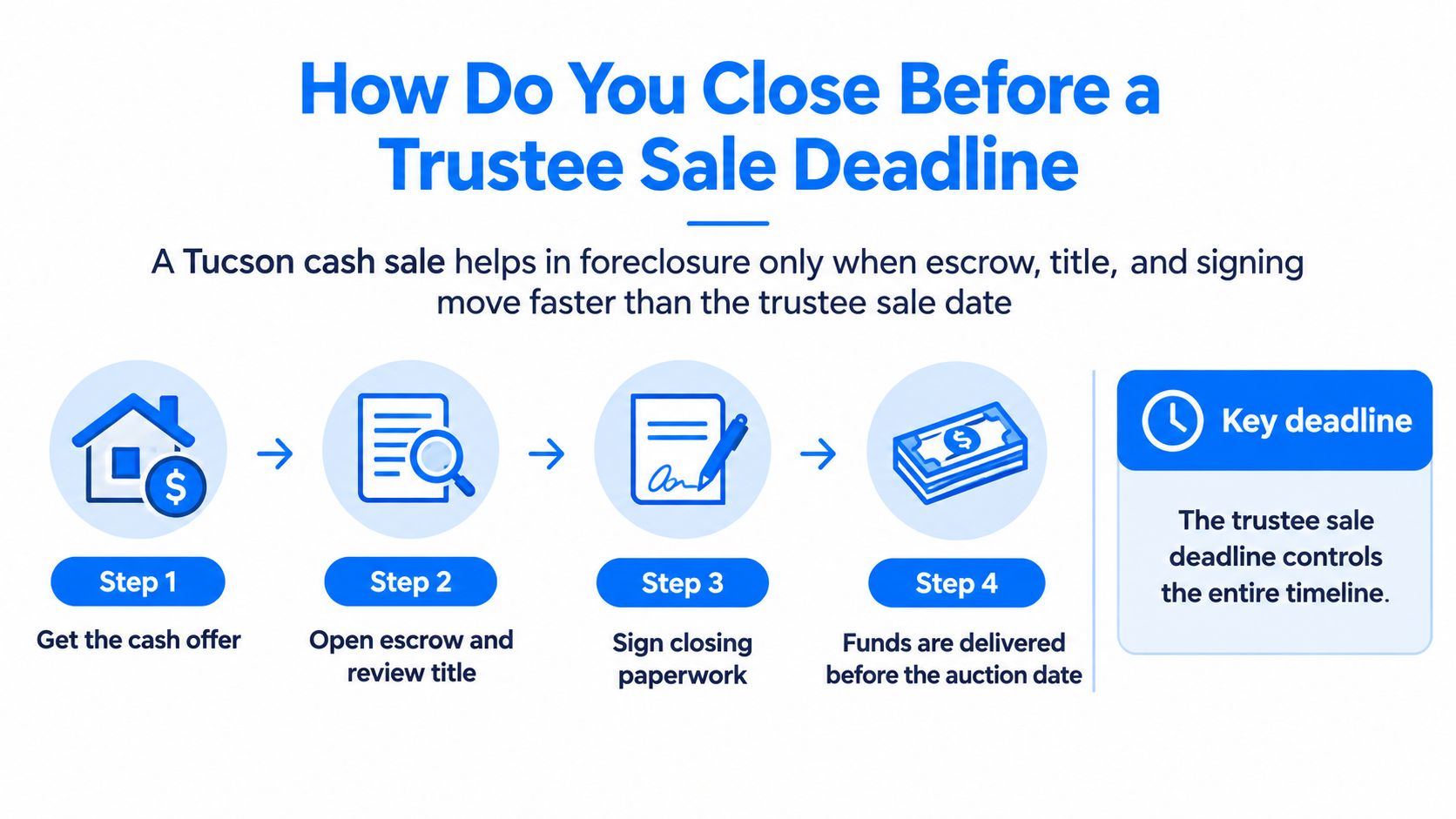
A Tucson cash sale helps in foreclosure only when escrow, title, payoff, funding, and recording finish before the relevant deadline, and signing a purchase contract doesn't itself stop the sale. The buyer's promised speed must match the title company's ability to complete the transaction.
Local timing pressure is real: Recorder's Office data reported 425 Tucson-area foreclosures in 2025, compared with 265 in 2022, followed by 180 during the first four months of 2026 (Tucson foreclosure reporting). Those figures aren't a reason to accept the first offer.
What must happen between offer and closing?
Treat the opening timeline as a planning target, never an unconditional guarantee. A clean file can move quickly; unresolved ownership or payoff problems can't be wished away.
- Written offer and walkthrough: Provide access and accurate condition information so the buyer can finalize the price.
- Purchase agreement: Specify earnest money, inspection rights, cancellation rights, assignment terms, fees, and the closing date.
- Escrow and title search: Have the buyer open escrow promptly so ownership and recorded claims can be reviewed.
- Payoff verification: Give escrow the lender, lienholder, and servicing contacts needed to obtain current figures.
- Funding and recording: Confirm when escrow must receive cleared funds and complete the required recording.
Ask for those milestones in writing. “We close fast” doesn't tell you when money reaches escrow.
Which deadline controls?
A trustee-sale notice generally precedes a sale by about 91 days, while HOA and property-tax liens follow different procedures and redemption rules (Arizona foreclosure and excess-proceeds guidance). Have an Arizona real-estate attorney or the appropriate professionals confirm your actual deadline.
Contact your mortgage servicer and a HUD-approved housing counselor promptly. A buyer's explanation of distressed property situations can provide background, but it isn't a substitute for deadline-specific legal advice.
Deadline check: Ask escrow what must be received, funded, and recorded before treating the proposed closing date as achievable.
When you still owe a mortgage or liens, escrow generally obtains payoff statements and disburses the required amounts from the purchase money. You shouldn't need to pay the lender informally on the side.
If the offer won't cover the debt and closing obligations, a short sale or other lender approval may be necessary. Don't assume that requesting approval pauses the auction.
What Documents and Disclosures Still Apply in Arizona
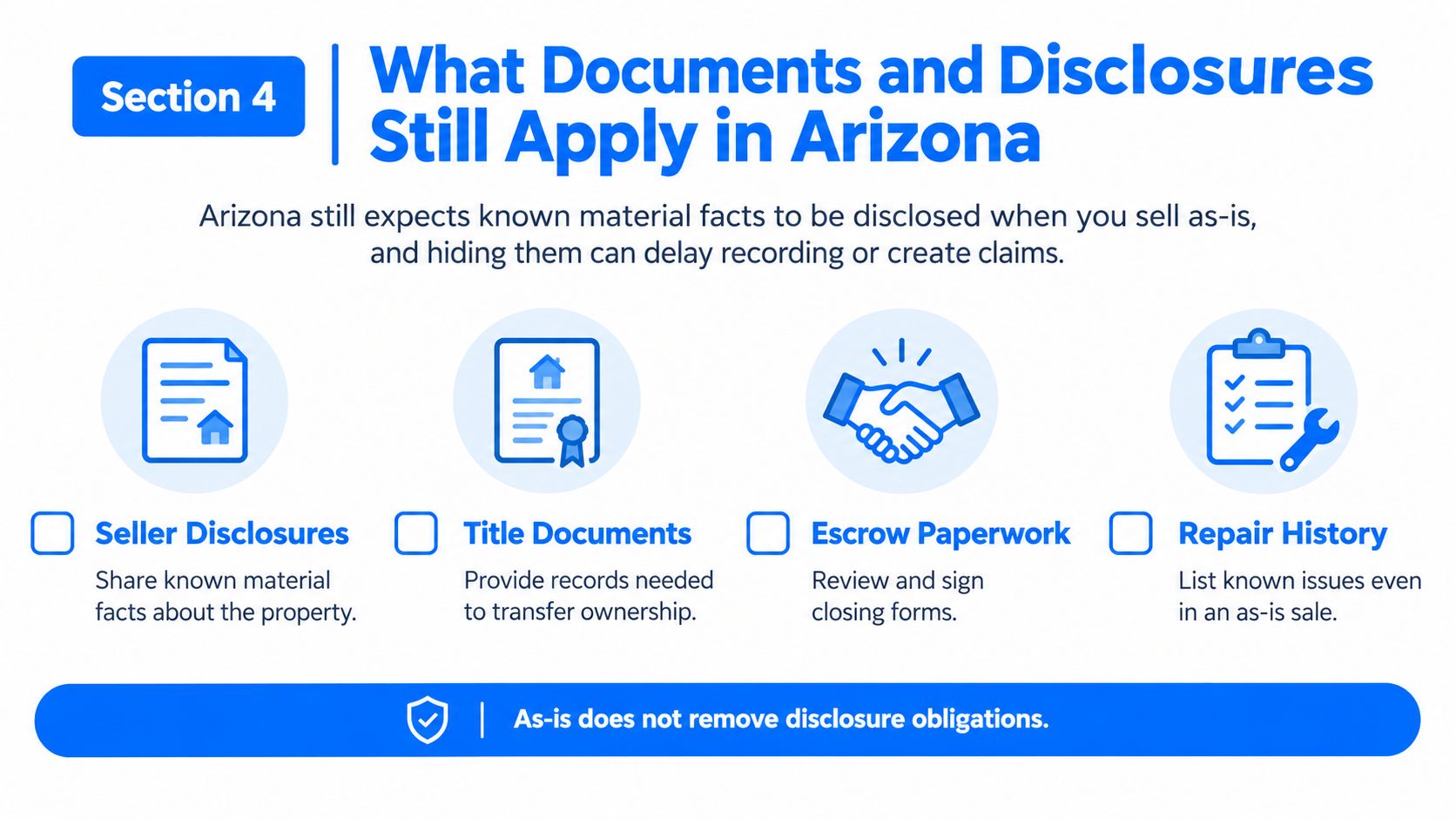
Arizona sellers must still disclose known material facts when selling as-is, and concealing them can create disputes or post-closing claims. Accepting a home's condition doesn't give a buyer accurate information about defects the seller hides.
Sellers generally use the Arizona Association of Realtors' Residential Seller's Property Disclosure Statement, or SPDS. Arizona disclosure principles, including Hill v. Jones, address known facts that materially affect value, even when a buyer hasn't specifically asked (Arizona seller disclosure and closing overview).
Which forms and closing rules apply?
A separate statutory affidavit applies to certain transfers of five or fewer parcels in an unincorporated county area. It must be delivered at least seven days before transfer, and the buyer has five days after receipt to rescind; a waiver of liability for omissions or misrepresentations isn't binding (Arizona affidavit-of-disclosure statute).
Arizona doesn't require an attorney for an ordinary residential closing; title or escrow companies typically handle the transaction. Legal help is sensible when probate, divorce, boundaries, or ownership are disputed.
Arizona has no state real-estate transfer tax. The Arizona closing overview linked above identifies a $2 Affidavit of Property Value fee under A.R.S. § 11-1133; confirm current recording charges and transaction requirements with your title company.
What should you gather?
- Identity and ownership: Identification, deed, trust documents, and probate authority where applicable.
- Debt records: Mortgage statements, tax and lien notices, HOA balances, and payoff contacts.
- Condition records: SPDS, permits, repair invoices, insurance claims, and known defect information.
- Occupancy information: Leases, deposits, access arrangements, and tenant notices.
- Government correspondence: Code-enforcement notices, unresolved permit issues, and related deadlines.
For cooling equipment, gather service records rather than guessing at its remaining life. Comfort Experts' Arizona AC replacement decision resource can help frame questions for a technician.
If the property is vacant or has code violations, ask the relevant Tucson or Pima County office which maintenance, security, registration, or correction requirements apply to that address. Don't assume vacancy or a pending sale suspends an existing notice.
How do you verify the buyer?
Require verifiable proof of funds, an independent local title or escrow closing, and clear earnest-money terms. Check recent reviews, ask about completed transactions, and avoid paying an upfront fee to receive an offer.
An inspection-based price change deserves an explanation tied to new findings, not pressure. Also ask whether the buyer intends to close or assign the agreement to another purchaser, a practice often associated with wholesaling.
How Should You Choose a Buyer and Take the Next Step
Choose the buyer who can fund on a date that solves your actual problem under terms you understand. The highest offer isn't useful if the purchaser can't perform, and the fastest offer isn't automatically your best financial choice.
Match the contract to your situation before committing. An inherited property may need signing authority established, while divorce may require agreement about who can sell and how proceeds are distributed.
What changes for a complicated property?
- Inherited or probate property: Confirm who has authority to sign and whether additional approvals are needed.
- Tenant-occupied rental: Provide the lease and arrange lawful access, occupancy, and deposit handling.
- Back taxes or other liens: Get the claims into the title review before relying on a proposed date.
- Fire, water, or hoarding damage: Document known conditions and agree on contents removal instead of making vague cleanup promises.
- Code violations: Identify what remains unresolved and have the contract address responsibility clearly.
For taxes, the home-sale capital-gains exclusion can be up to $250,000 for a qualifying single owner or $500,000 for a qualifying married couple. Eligibility depends on your circumstances, so consult a tax pro rather than assuming all sale proceeds are exempt.
A list of cash buyers in Tucson can help you identify candidates. Evaluate the actual purchasing entity, contract, funds, and settlement statement rather than relying on a “we buy houses Tucson” advertisement.
Can I sell my house as-is in Tucson without cleaning it out?
You can negotiate a sale with belongings or debris remaining. Put the exact agreement in writing, including anything you intend to keep.
Does as-is mean the buyer can't inspect?
No, inspection rights depend on the contract. Read the inspection deadline and cancellation language before assuming the price is firm.
Can I sell a house without repairs in Tucson through an agent?
Yes, an agent can market the home in its present condition. You'll still need to consider buyer requests, access, and whether the likely purchaser can complete the transaction.
Can I sell after receiving a Notice of Trustee's Sale?
A sale may still be possible, but escrow must confirm the required documents and completion deadline. Ask for a transaction-specific list covering ownership authority, payoff information, and any lender or trustee requirements.
What if the cash buyer uses private money?
Ask who supplies the funds and whether funding has conditions. Private-money financing shouldn't be treated as immediately available cash without verification.
Should I accept the first cash offer?
Not because it's first or labeled urgent. Compare written offers against your realistic listing alternative and the cost of waiting.
Will selling fast eliminate my tax obligations?
No, speed doesn't determine tax treatment. An inherited home, rental, and primary residence can raise different tax questions, so obtain individual advice.
What's the safest next step?
Gather the documents, request the written offer and proof of funds, and have an Arizona title company review the proposed settlement figures. Resolve unclear fees and cancellation terms before signing.
Cyber Homes offers an as-is cash or private-money purchase option for Tucson homeowners who want to avoid repairs and public showings. Visit Cyber Homes to request an evaluation and discuss a closing date, then compare the written net proceeds and funding terms with your other options.
Edited by
James Vasquez
Real Estate Investor & Land Specialist with 10+ years experience in residential flipping, vacant land investing, land wholesaling, and subdivision deals.
Disclaimer: The information provided is for educational purposes and does not constitute financial or legal advice. Always consult with licensed professionals before making investment decisions.