
10 Home Investors Near Me: Compare Cash Offers

The roof needs work, the spare room is full of boxes, and you've got a moving deadline you can't shift. You search home investors near me, call a few numbers, and discover that one company buys houses, another sends your details to investors, and another wants to put the property in front of bidders.
Those aren't interchangeable services. A direct buyer negotiates its own purchase. An investor marketplace lets investors compete for the property. A matching service introduces you to someone else, who may become the buyer.
The options below are grouped by the control you keep: negotiating directly, comparing through an intermediary, or accepting a structured offer with eligibility rules. The order isn't a quality ranking. A national company can still make a local offer, but “near me” should mean someone understands your property and can close, not merely that its advertisement appeared nearby.
A cash offer usually trades price for speed and convenience. It isn't the route to assume will produce the highest sale price.
Compare the named purchaser, final net proceeds, cancellation rights, and closing obligations. If tenants or disputed occupancy complicate the sale, consider hiring a landlord-tenant attorney before promising vacant possession. A buyer's willingness to purchase doesn't settle your legal obligations.

1. Cyber Homes
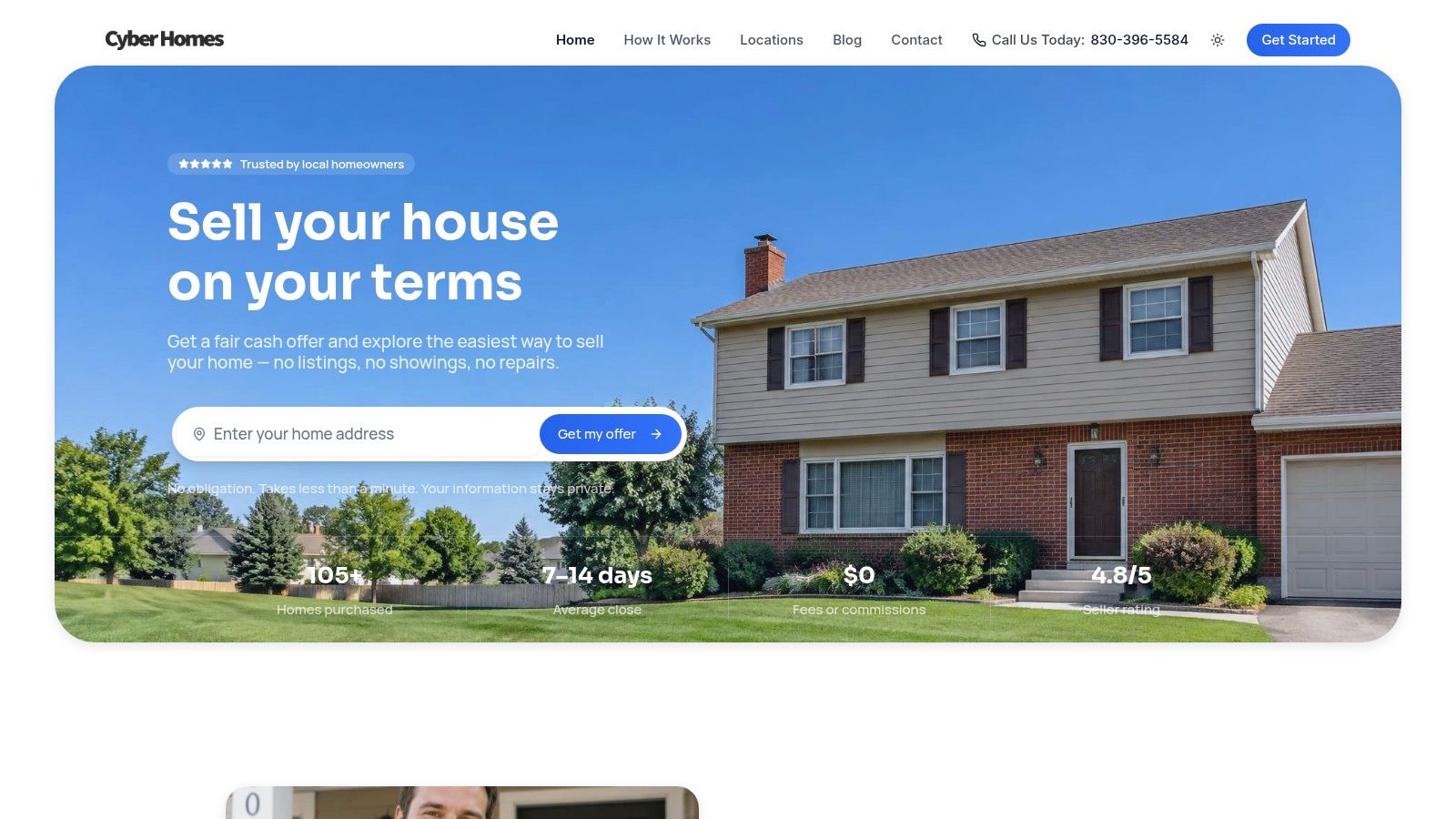
Model: Direct buyer. You negotiate a sale rather than publish a listing or wait for introductions. We're a family-owned investment company buying homes as-is across the country, including properties with costly repairs, inherited ownership, problem tenants, or foreclosure pressure.
Our process starts with a property evaluation and a review of local sales. We then present a no-obligation cash offer, usually within 24 hours. You don't need to repair the home, prepare it for showings, or list it with an agent.
The practical benefit is a simpler transaction. We charge no commissions or fees and cover closing costs. That lets you compare the offer without subtracting a separate service charge, although mortgage payoffs, liens, and other obligations attached to your property still matter.
What You Control
You decide whether the offer works and choose your preferred closing timeline. We offer a guaranteed cash close, handled through a reputable title company, rather than requiring you to find a financed retail buyer.
- Property preparation: You can sell without repairs, cleanup for showings, or an open house.
- Communication: A consistent point of contact helps keep the evaluation and closing instructions connected.
- Transition support: An advance for moving expenses may be available, with its terms documented before you accept it.
The trade-off is price discovery. A direct offer doesn't expose the house to every possible retail purchaser. If the home is market-ready and you have time, compare an agent's realistic net-proceeds estimate before choosing convenience.
Our strongest fit is a seller who knows the constraint: a difficult property, an approaching move, or a need for certainty. We aren't a substitute for independent legal advice when ownership, probate, or tenant rights remain unresolved.
2. HomeVestors / We Buy Ugly Houses

A familiar national brand doesn't mean a centralized buying desk. HomeVestors works through locally operated franchisees, so the local business evaluating your home matters more than the name on the advertisement.
Model: Local direct buyer within a franchise network. A representative typically assesses the property in person and may make an as-is offer. This can suit a house with deferred maintenance that you don't want to prepare for retail buyers.
The useful part is access to a local operator. The limitation is variation: communication, purchasing capacity, contract language, and closing arrangements can differ between independently operated businesses.
Evaluate the Franchisee, Not Just the Brand
Ask for the purchaser's legal name before treating a conversation as an offer. Match that name against the purchase agreement and the information supplied to the closing company.
- Best fit: Owners who want an in-person assessment and a direct negotiation over a repair-heavy property.
- Main trade-off: The investor needs room for repairs, holding costs, resale expenses, and profit.
- Contract check: Identify inspection rights, assignment provisions, earnest money, and the circumstances permitting cancellation.
An offer described as as-is can still contain an inspection contingency. Those concepts aren't opposites: one addresses repairs you must perform, while the other may let the buyer reconsider.
Don't stop comparing because the representative seems knowledgeable. A useful local explanation should connect the property's condition to the offer, then explain exactly when that amount becomes firm.
3. We Buy Houses
We Buy Houses is a brand, but the phrase is also used by unrelated advertisers. That makes identity verification especially important when comparing results from a search for home investors near me.
The official We Buy Houses website helps sellers locate affiliated local buyers. Model: A local buyer operating under a national brand, rather than a single centrally operated purchaser making every offer.
For a homeowner, that means the local buyer's capacity and contract deserve separate scrutiny. Neighborhood knowledge can help an investor evaluate a difficult house, but it doesn't guarantee a favorable price or a dependable closing.
Verify Before Sharing Sensitive Documents
Start with the official market directory. Then confirm who will sign, who will fund the purchase, and which title or escrow company will handle the transaction.
Use this guide to we-buy-houses scams to recognize identity and contract issues before sending sensitive financial information.
- Useful feature: Access to an affiliated buyer who may understand local repair and resale conditions.
- Seller responsibility: Confirm that the business contacting you is the business you intended to reach.
- Warning sign: A representative avoids naming the purchaser or pressures you to sign before explaining cancellation rights.
Don't confuse a friendly conversation with committed funds. Ask for proof of funds appropriate to the purchasing entity, and have the closing company verify the transaction independently.
This option suits sellers comfortable evaluating a local operator. It's less useful if you expect a national brand to make every office's terms identical.
4. House Buyers of America

A house with an aging kitchen and unfinished repairs doesn't necessarily need a renovation before sale. House Buyers of America presents a direct, as-is purchase option for owners who would rather transfer the work to the buyer.
Model: Multi-state direct buyer. The company describes purchases without seller fees or commissions, with availability dependent on the property and location. Confirm coverage for the address before spending time on an evaluation.
Its appeal is straightforward: negotiate with a purchaser instead of preparing a listing. Its limitation is equally straightforward: no commission doesn't mean retail pricing.
Separate Selling Costs From Your Own Obligations
A buyer can cover transaction expenses without paying your mortgage balance, tax debt, or unrelated estate obligations. Have the title company distinguish buyer-paid costs from amounts deducted to deliver clear title.
- Good use: A seller wants an as-is offer without organizing contractors or managing showings.
- Important comparison: Put the proposed net proceeds beside an agent's estimate that includes preparation and carrying costs.
- Timing concern: Title defects can prevent a quick closing even when the buyer has available cash.
For inherited property, establish who has authority to sign before negotiating a deadline. A willing buyer can't replace missing estate authority or resolve disagreement among owners by advertising speed.
Ask for the written offer and a preliminary settlement breakdown together. That combination is more useful than a verbal price because it shows what you may receive and what still needs to be resolved.
5. HomeGo
A later move-out can matter more than an earlier closing. If you need sale proceeds before arranging your next home, evaluate possession terms as carefully as the offer amount.
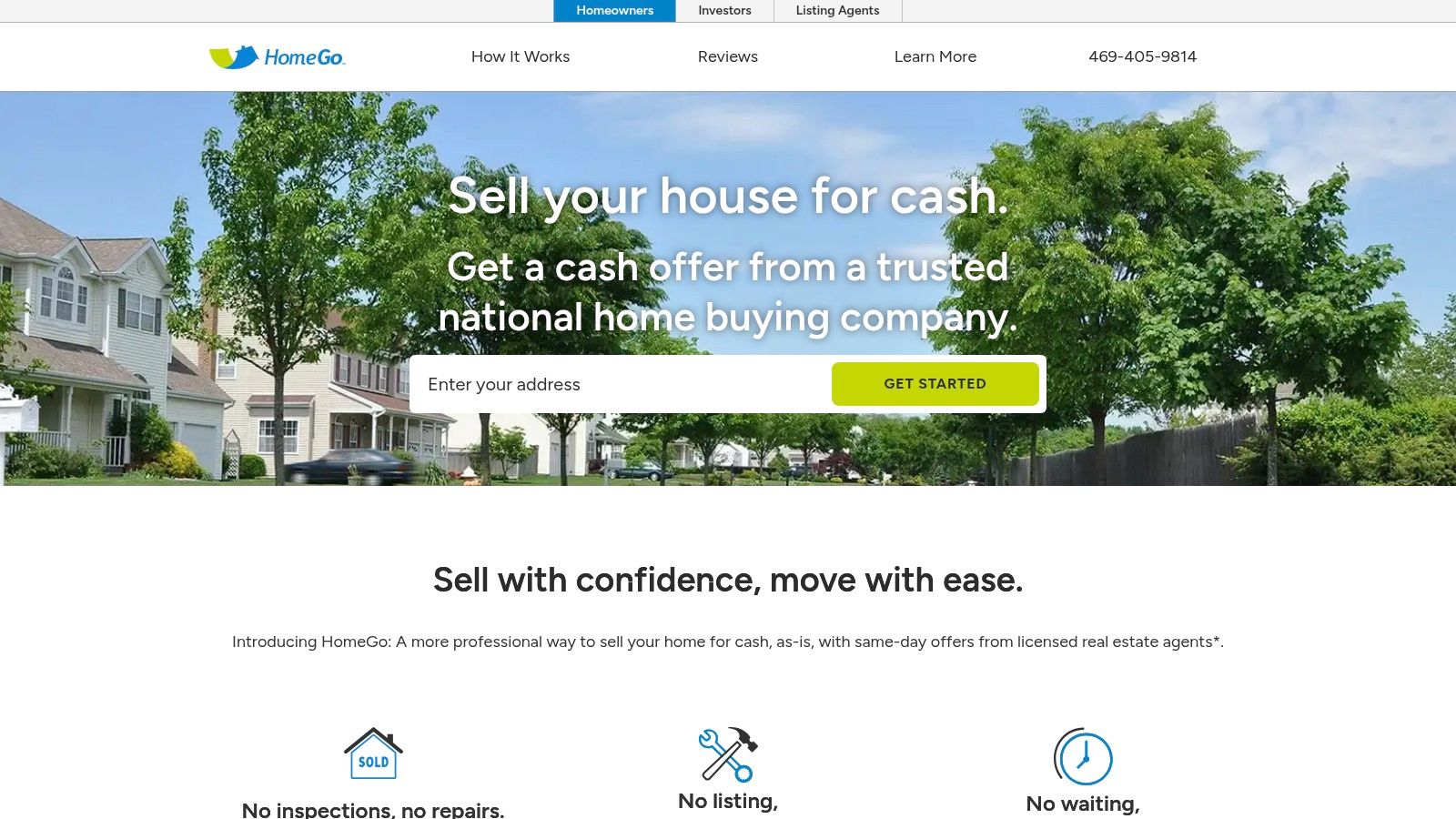
HomeGo describes a direct-buying process built around a representative walkthrough, an as-is offer, and flexible closing arrangements. It also describes a possible leaseback option for eligible sellers.
Model: Direct buyer with potential move-out flexibility. That may suit someone who wants to discuss the property face-to-face rather than rely entirely on an online questionnaire.
The walkthrough is useful for identifying obvious condition concerns. It isn't a promise that every issue, deduction, or contractual condition has been settled.
Treat a Leaseback as a Separate Agreement
If you remain after closing, you're occupying a house you no longer own. Get the occupancy arrangement in writing rather than relying on the salesperson's summary.
- Occupancy cost: Identify rent, deposits, holdbacks, and any amounts withheld from sale proceeds.
- Responsibility: Specify utilities, insurance, maintenance, and responsibility for damage.
- Move-out terms: Record the possession deadline and consequences of staying beyond it.
HomeGo may be worth comparing when relocation logistics are the main obstacle. It's less compelling if you don't need flexibility and another buyer produces stronger net proceeds with fewer conditions.
Check local property eligibility before arranging access. For rentals, disclose existing leases and occupancy accurately; don't promise that tenants will leave unless you have a lawful, workable plan.
6. HomeLight Simple Sale

HomeLight Simple Sale is useful when you haven't decided whether speed justifies accepting less. Its process presents a cash-sale option alongside an estimate for an agent-listed sale.
Model: Matching service using an investor network. HomeLight may arrange the introduction without becoming the purchaser. Your control comes from comparing routes, not necessarily negotiating directly with HomeLight.
Cash itself isn't unusual: 26% of primary-residence buyers paid entirely in cash in the National Association of REALTORS®’ 2025 survey covering transactions from July 2024 through June 2025, according to NAR's profile announcement. That doesn't establish investor market share or validate a particular buyer's offer.
Compare Like With Like
An estimated listing price isn't equivalent to cash in your account. Ask what preparation, marketing time, concessions, and selling expenses the listing estimate assumes.
- Useful feature: A side-by-side view can expose the price you're paying for convenience.
- Main limitation: Investor availability and appetite affect whether a suitable offer appears.
- Identity check: Confirm the purchaser named in the contract and the entity providing funds.
Keep the assumptions consistent. If the listing estimate assumes repairs you won't perform, it isn't an appropriate benchmark for your current situation.
Simple Sale is a sensible comparison tool, especially for an undecided seller. It doesn't remove the need to inspect the investor's purchase agreement, fee disclosures, or rights to withdraw after evaluation.
7. Sundae
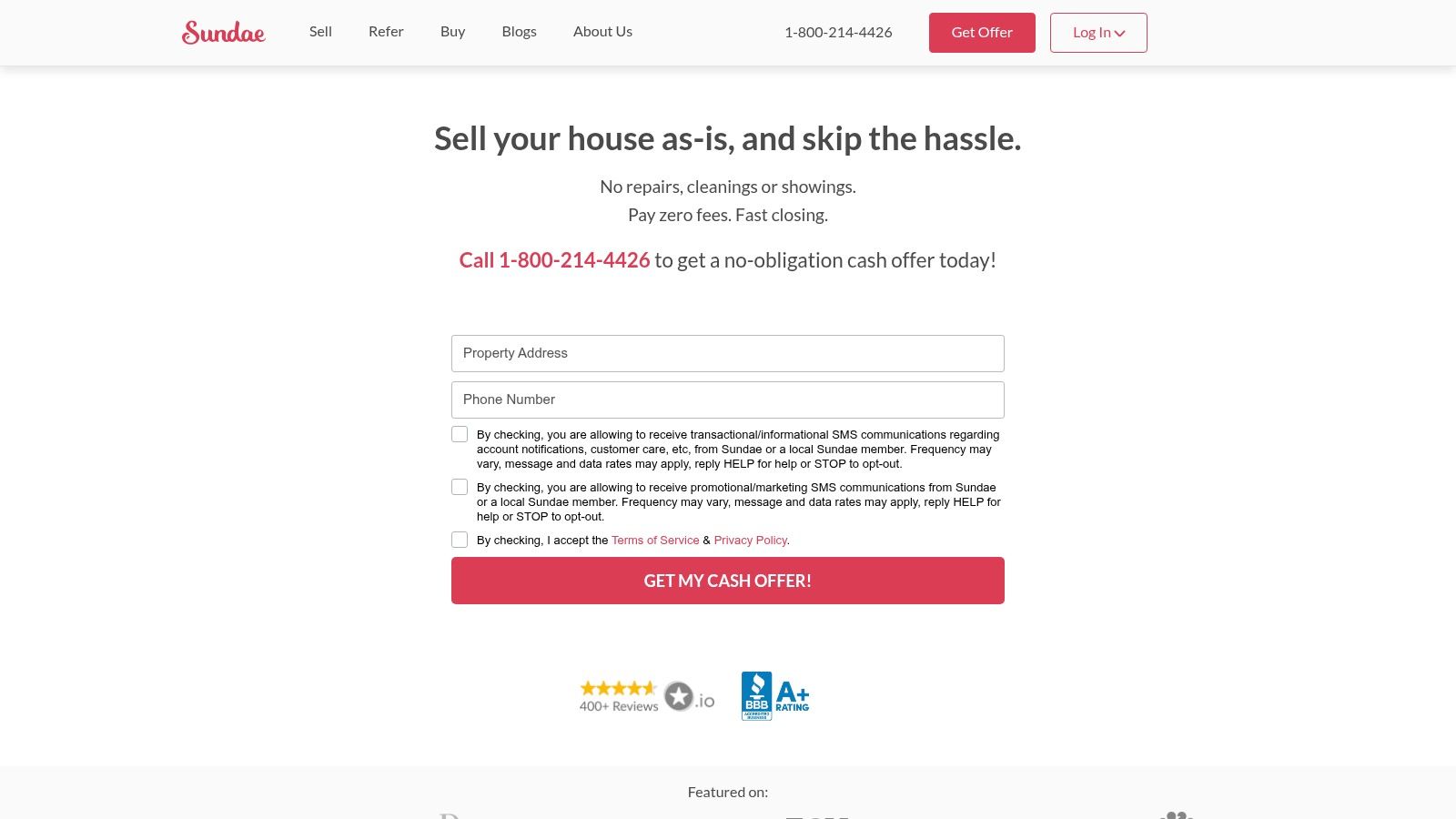
Prefer to let investors compete rather than negotiate with whichever buyer answers first? Sundae offers an investor marketplace for as-is properties in selected markets.
Model: Investor marketplace. The service prepares property information for participating investors, who can submit offers. The investor purchasing your home may be a separate business from Sundae.
That creates a different kind of control. You can compare bids generated through a shared process, but you still need to evaluate each bidder's conditions and ability to close.
Competition is useful only when you compare executable offers, not just the largest opening number.
Look Beyond the Bid Amount
A higher bid with broad cancellation rights may be less useful than a lower offer with completed diligence. Ask when the investor's evaluation ends and what can still change afterward.
- Preparation: Confirm what access is needed for photos, property documentation, and evaluation.
- Advance terms: If financial assistance is offered, understand repayment and cancellation consequences.
- Buyer identity: Verify the investor signing the agreement rather than assuming the marketplace guarantees performance.
This guide to as-is home buyers can help distinguish a property-condition promise from the buyer's inspection rights.
Sundae may suit an inherited house or repair-heavy rental where investor competition is more relevant than polished retail marketing. Availability is limited by market, and participating investors may assess the same defects differently.
For an estate sale, circulate the actual bids and net estimates to the authorized decision-makers. A documented comparison is more defensible than choosing an offer based on a phone conversation alone.
8. Offerpad

A structured online offer can simplify the process, but it doesn't eliminate deductions. Offerpad provides a direct-sale option for eligible properties in selected markets, without requiring a conventional listing or public showings.
Model: Technology-enabled direct buyer. Sellers submit property information and move through an evaluation process. The offer needs to be read alongside service charges, condition adjustments, and closing expenses.
This route can work well when the house fits the company's purchasing criteria and you prefer a defined process. It's less useful when you need a buyer willing to negotiate around unusual property characteristics or unresolved legal complications.
Request the Entire Offer Breakdown
Don't compare the headline purchase amount against another buyer's net offer. Ask for every deduction and identify which amounts are final.
- Service charge: Separate it from closing costs rather than combining everything under fees.
- Condition adjustment: Ask what finding supports the deduction and whether it can change.
- Moving assistance: Check eligibility and restrictions before treating it as money saved.
If Offerpad also presents a listing route in your market, keep that agreement separate from the direct-sale comparison. Different services can create different obligations.
A usable offer should make the sequence clear: property evaluation, final pricing, acceptance, closing, and possession. Ask what happens if you decline a revised offer after the evaluation.
Choose this option for process convenience, not because an online estimate feels more objective than a local investor's assessment. Both require judgment about condition and resale value.
9. Opendoor
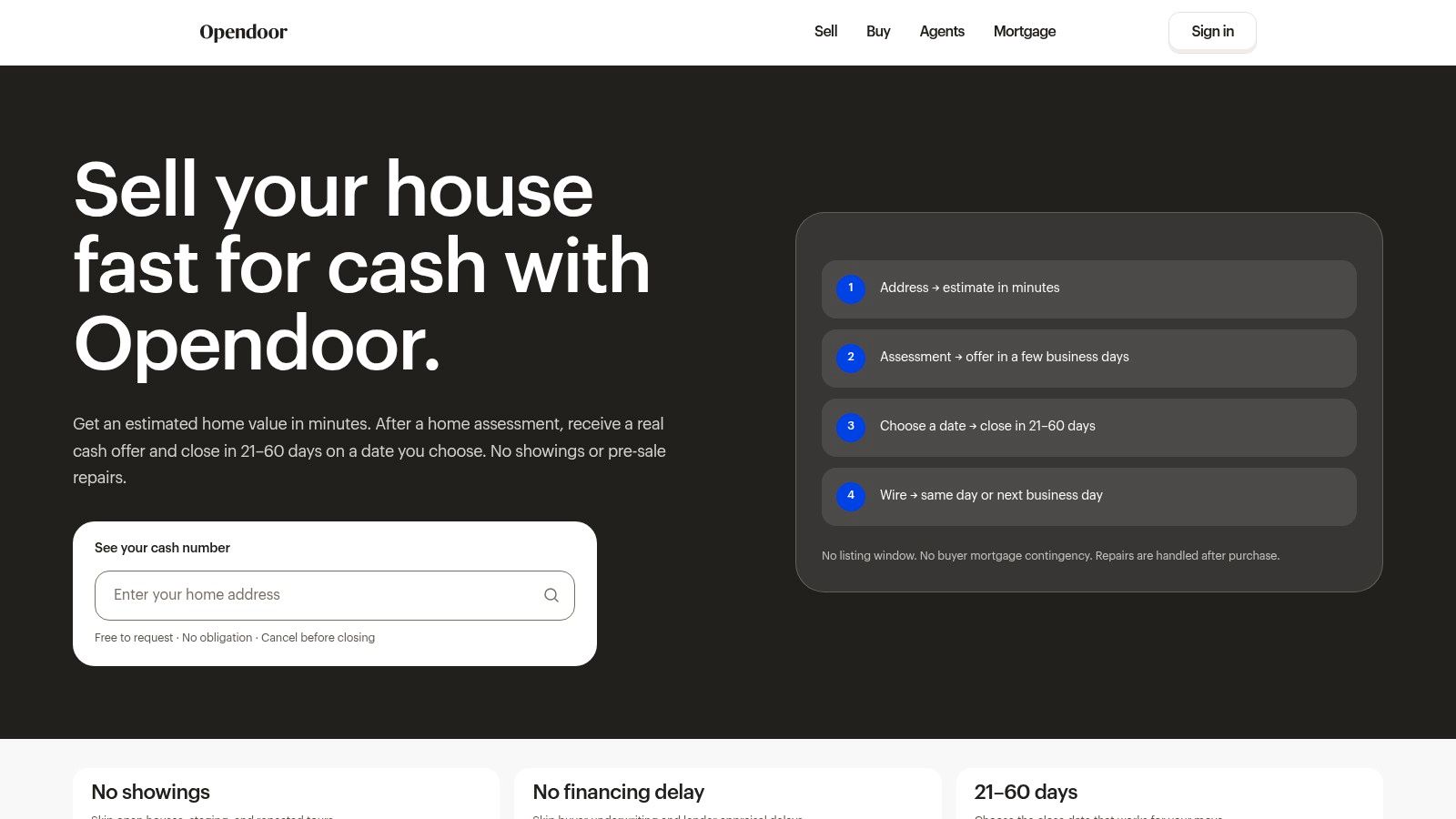
A relatively standard home can be a better fit for an online direct buyer than a property with major structural problems or unusual use. Opendoor's cash-sale service operates within market and property eligibility rules.
Model: Technology-enabled direct buyer. You submit information, receive an evaluation, and review an offer with applicable charges and adjustments. The attraction is avoiding listing activity while working toward a defined closing.
The important distinction is between an initial estimate and an accepted purchase agreement. Don't make irreversible moving arrangements based only on the first number displayed.
Find the Point Where Pricing Becomes Firm
Use this explanation of the cash home buying process to separate preliminary evaluation from contractual commitments.
- Condition review: Establish whether further access or documentation is required.
- Offer deductions: Identify service charges, condition adjustments, and estimated closing costs separately.
- Exit rights: Read what permits either side to cancel and whether any deadlines apply.
Opendoor may be practical when your property fits its criteria and you value limited disruption. A house with unusual features may need a buyer willing to evaluate those details individually.
Compare the written net amount with a realistic listing alternative. A home that needs little work may attract retail buyers, so the convenience discount deserves particular attention.
Keep closing and possession distinct. The day ownership transfers and the day you must leave should both be clear before you sign.
10. Express Homebuyers

Regional coverage can be an advantage when the buyer understands the local transaction process. It's also a hard limit if the property falls outside the service area.
Express Homebuyers describes direct, as-is purchases in Virginia, Maryland, Washington, D.C., and parts of Florida. Model: Regional direct buyer, rather than an investor marketplace.
The company considers situations including inherited homes, rentals, and foreclosure-related sales. Its process involves property review, a written offer, and closing through a title company.
A Deadline Needs More Than a Fast Buyer
For foreclosure, confirm the actual sale or legal deadline with the appropriate professional. A purchase agreement alone shouldn't be treated as proof that an existing proceeding has stopped.
Foreclosure remains a real but specialized situation: ATTOM's year-end report recorded filings on 367,460 U.S. properties in 2025, still 25% below 2019. Your decision should depend on your own timeline, not a buyer's broad claims about distressed inventory.
- Practical fit: Sellers inside the service area who want an as-is regional buyer.
- Closing dependency: Mortgage payoff information, liens, estate authority, and ownership disputes can affect timing.
- Verification: Confirm the purchasing entity, funds, and closing instructions independently.
If unwanted belongings remain, document what may be left behind. If tenants remain, document the tenancy rather than treating the property as vacant.
A credible deadline starts with a title review and a workable closing plan. Ask who is responsible for each unresolved item and when it must be completed.
Buyer type, coverage, stated costs and closing speed side by side
Same closing week, very different control. A direct buyer writes one number and one contract. A marketplace or matching service can put several investors in front of you, then the fee and the date still depend on who funds the purchase.
| Company | Buyer type | Coverage | Stated fees or costs | Typical closing speed | Best for |
|---|---|---|---|---|---|
| Cyber Homes | Direct cash buyer | Dallas, Denver, Miami, Phoenix, San Diego, Atlanta, and other markets | No commissions or fees; covers closing costs | Offer within 24 hours; closing on your preferred timeline | Sellers prioritizing speed, certainty, and an as-is sale |
| HomeVestors / We Buy Ugly Houses | Local franchise buyers | Nationwide local network; availability varies by franchise | Not specified; offers typically below market value | Sometimes about three weeks | Sellers seeking convenience for homes needing repairs |
| We Buy Houses | Network connecting sellers with local buyers | Depends on local investors in its network | Not specified; direct investor offers may mean lower proceeds | Local representative typically contacts sellers within 24 hours; closing time not specified | Sellers seeking a local buyer for a faster as-is sale |
| House Buyers of America | Direct cash buyer | Many states; eligibility varies by property | No seller fees or commissions, according to the company | As little as seven days | Sellers seeking a direct buyer and fast closing |
| HomeGo | Direct home-buying company | Many states; coverage is not universal | No commissions, repairs, or closing costs, according to the company | Same-day offers may be available; closing timing is flexible | Sellers wanting an as-is sale with flexible move-out timing |
| HomeLight Simple Sale | Investor-matching service | Depends on investor availability | Free to request an offer; fees disclosed before signing | Offer comparison in about 24 hours; cash closing in as few as 10 days | Sellers comparing a cash offer with a potential listing |
| Sundae | Investor marketplace | Selected metro areas | Not specified | Advertised closings from 10 to 60 days | Sellers who want to compare investor offers for an as-is home |
| Offerpad | Direct buyer with some listing options | Selected U.S. metro areas | Service fee, closing costs, and condition adjustments may apply; the amount varies | Advertised window of 8–60 days | Sellers who want a direct sale with published fee terms |
| Opendoor | Direct cash buyer | Active markets; property eligibility varies | Variable service charge; condition adjustments and closing costs may apply | Eligible sellers may choose a date 21–60 days out | Sellers seeking a predictable sale without listing or showings |
| Express Homebuyers | Regional direct buyer | Virginia, Maryland, Washington, D.C., and parts of Florida | Not specified | 7–14 days claimed; two to four weeks described as typical | Sellers in its service area with repair needs or inherited homes |
A cash offer trades price for speed. Buyer type decides whether you can still compare that price.
Seven of these names buy direct: Cyber Homes, HomeVestors, House Buyers of America, HomeGo, Offerpad, Opendoor, and Express Homebuyers. One counterparty. Less room to shop the number after the walkthrough.
We Buy Houses and Sundae leave more choice with you and more of the calendar with a local fund. HomeLight Simple Sale is the matching option: free to request, with fees meant to show before you sign. Use it to set a cash figure beside a possible listing, not when you already need one buyer on a fixed date.
Ask who the purchasing entity is, which costs come off the price, and which date survives a worse inspection. If those three move, the quote was never an offer.
Pick the Buyer Who Explains the Number
Choose around your actual constraint. A hard relocation deadline favors dependable execution; substantial damage favors a buyer comfortable with repairs; unresolved ownership requires legal work before speed matters. If price is your priority and the property can attract retail buyers, test the listing alternative.
Agent-assisted selling remains the conventional route: 91% of sellers used a real estate agent in NAR's 2025 profile highlights. That doesn't make it right for every property, but it deserves a realistic comparison rather than dismissal.
Build a Line-by-Line Net-Proceeds Estimate
Use a spreadsheet with a separate column for each written offer and the listing alternative. Work from the same anticipated closing date where possible.
- Purchase price: Start with the amount offered, not a promotional estimate.
- Selling charges: Subtract commissions, service charges, and other seller-paid fees.
- Condition costs: Subtract repairs you'll fund, repair credits, or buyer deductions.
- Closing expenses: Subtract your allocated title, escrow, transfer, and settlement costs.
- Ownership obligations: Subtract mortgage payoffs, liens, unpaid taxes, and applicable prorations.
- Time and possession: Subtract carrying costs through closing, plus leaseback or moving costs specific to that option.
Don't count the same expense twice. If a repair deduction is already reflected in the purchase price, don't subtract it again.
Ask These Six Questions
Use the same questions with every buyer so you can compare answers directly.
- Purchaser: What legal entity will buy the house, and can it provide proof of funds?
- Final price: Is this amount firm, and exactly what can reduce it?
- Deductions: What fees, closing costs, and condition adjustments will I pay?
- Exit rights: Can you inspect, cancel, or assign the contract, and until when?
- Closing: Which independent title or escrow company will close, and what could delay funding?
- Possession: When must I leave, and are belongings, tenants, advances, and occupancy terms documented?
Signing rule: Put the closing date, price-change conditions, and every material promise in the purchase agreement.
Today, request two or three written offers, run the net-proceeds calculation, and ask those questions. Confirm the purchaser and closing company independently. Don't sign while the closing date or the circumstances allowing price changes remain unwritten.
We buy houses as-is, charge no commissions, and cover closing costs, giving you a direct offer to compare with other local investors. Visit Cyber Homes to request a no-obligation cash offer and discuss your property, preferred timeline, and expected proceeds.

Edited by
James Vasquez
Real Estate Investor & Land Specialist with 10+ years experience in residential flipping, vacant land investing, land wholesaling, and subdivision deals.
Disclaimer: The information provided is for educational purposes and does not constitute financial or legal advice. Always consult with licensed professionals before making investment decisions.