We Buy Houses for Cash in Austin, TX: A Local Guide
 Edited byJames Vasquez
Austin's 2026 median sale price sits roughly between $426,220 and $550,000, while median time on market runs about 58 to 78 days. A cash offer can close that timing gap, but the tradeoff is a lower price in exchange for certainty, no repairs, and a firm closing date.
A homeowner in Travis County may be behind on payments, managing an inherited property after a parent's death, or staring at a dated East Austin house that needs more work than the budget allows. Listing traditionally can still produce the highest gross price, but it also means preparing the property, handling showings, waiting through buyer negotiations, and carrying the home while it sits.
Cyber Homes buys Austin properties as-is for cash, including homes with repairs, probate complications, tenant issues, or urgent deadlines. The sections below explain the Texas paperwork, Travis County closing mechanics, realistic selling costs, a worked net-proceeds comparison, and the practical difference between listing and accepting a direct cash offer.
How to Sell a House Fast in Austin, TX
A homeowner in Travis County who is facing foreclosure, settling an estate, relocating, or holding a repair-heavy property has two practical choices. List on the MLS and wait through a buyer's market, or accept a lower cash price for a firm closing date. Austin listings may take roughly 58 to 78 days, depending on the area and dataset. Austin market pricing and 2026 trends and Austin resale market conditions document that local timing.
A cash sale gives up some price to remove repairs, showings, buyer financing, and extended carrying costs. Compare the offer with your likely MLS net, including commissions, concessions, utilities, insurance, taxes, and the cost of waiting. Speed has real value when a foreclosure deadline is approaching or an inherited house cannot be sold until the estate paperwork is organized.
Start with the right sale path
- Compare certainty with the realistic MLS net.
- A listing can produce a higher gross price, but the amount you keep depends on preparation, negotiations, concessions, and ownership costs during the marketing period. Ask for a written cash offer and a written listing estimate that shows expected expenses.
- Give complete property information.
- Whether you speak with a buyer or an Austin listing agent, provide the address, ownership status, mortgage balance, occupancy, known liens, condition, and deadline. A serious buyer should explain the purchase price, requested documents, and closing costs before you sign.
- Complete Texas disclosures accurately.
- Use the Texas Real Estate Commission Seller's Disclosure Notice, commonly called TREC OP-H. Report known material defects, then provide MUD, HOA, flood, and lead-based-paint information when applicable. Selling a house as-is does not permit a seller to conceal known problems.
- Open title with a Texas title company.
- Austin residential closings usually run through a title company, which coordinates the title search, payoff statements, deed preparation, settlement statement, signing, and recording. The search can reveal liens, unpaid taxes, ownership disputes, probate requirements, and other issues. Start this work before promising a closing date.
- Set the closing date in writing.
- A clean cash transaction may close in roughly 10 to 21 days. Title defects or other curative work can extend the process to 45 to 60 or more days. Austin distressed-property guidance reinforces that funding is only one part of the schedule.
- Sign and verify disbursement.
- At closing, the title company handles the deed, lender payoff, tax prorations, settlement figures, and distribution of funds. Do not rely on a verbal promise of a fast closing. Ask which title items are complete and whether the buyer's funds are verified.
- Confirm recording with the Travis County Clerk.
- The title company normally submits the deed for recording, but confirm that recording and lien releases are being handled. Keep copies of the signed documents and final settlement statement.
Probate adds another layer. The personal representative may need court authority or estate documents before signing. If you are asking, can you sell a house in probate in Texas, obtain legal guidance before accepting an offer, particularly when heirs disagree or creditors remain.
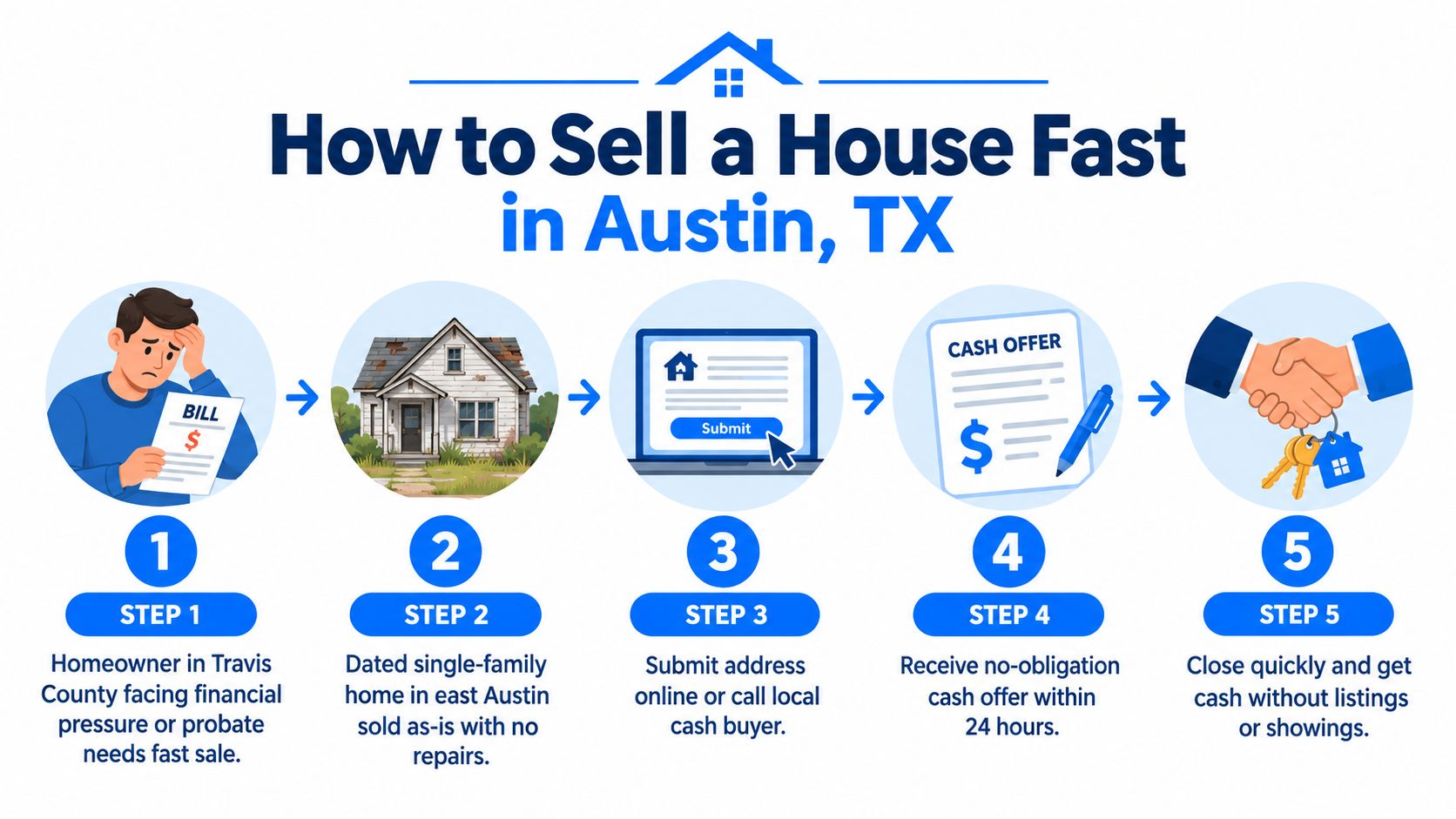
Cyber Homes buys Austin properties as-is for cash, including homes with repairs, tenant issues, probate complications, or urgent deadlines. Get the title work and paperwork started early, then choose the offer that best matches your deadline and expected net proceeds.
Documents Needed to Sell a House in Austin and Texas
Paperwork causes more delayed cash closings than buyer financing. Austin sellers should gather documents early, then let the title company identify anything missing.
- TREC Seller's Disclosure Notice, OP-H: Records known material defects and property conditions required by Texas disclosure rules.
- Current deed: Shows the legal owner and the ownership form. The title company may obtain a copy, but sellers should know what the deed says.
- Survey and T-47 affidavit: A current survey helps confirm boundaries, easements, improvements, and encroachments. An older survey may require a T-47 affidavit or an updated survey, depending on the buyer and title company.
- Warranty deed or special warranty deed: The title company prepares the deed used to transfer ownership.
- HOA resale certificate: Required when applicable. Condo properties may also require a condo resale certificate.
- Mortgage payoff statement: Shows the lender's current payoff amount and instructions for releasing the lien.
- Travis County property tax information: The title company orders tax figures and calculates prorations through the closing date.
- MUD or PUD district information: Provide district details and related disclosures when the property is located in one.
- Lead-based paint disclosure: Required for applicable homes built before 1978.
- Flood zone information: Disclose known flood-related information and provide any documents you have.
- Sales Price Information, or SPI: The title company uses this information to prepare the transaction file.
- Government identification and affidavit of title: You'll sign identification and title affidavits at closing.
The seller usually gathers the deed, survey, mortgage details, HOA contacts, leases, tenant information, probate documents, and repair records. The title company typically orders the title search, payoff figures, tax information, and prepares the closing documents.
Practical rule: Don't wait until signing to mention probate, tenants, unpaid taxes, divorce orders, or a second lien. Those facts affect title work and should be reviewed before the closing date is promised.
For questions about ownership defects, a plain-language explanation of color of title for homeowners can help you understand why possession alone isn't always enough to prove clean ownership. If an estate is involved, sellers can also review Cyber Homes' probate selling resource before contacting a buyer.
Cost to Sell a House in Austin and Texas
An Austin seller in 2026 is choosing between time and price. Listing on the MLS in a buyer's market can mean roughly 60 to 78 days on market, plus preparation, showings, negotiations, and carrying costs. A cash buyer usually offers less, but provides a faster, more certain closing. That certainty matters when Travis County taxes, title paperwork, foreclosure pressure, or probate makes delay expensive.
Austin pricing varies by geography. The metro and city can show different median figures, so sellers should compare the property's neighborhood and condition rather than rely on one headline number. The city and metro pricing comparison helps separate those markets.
A traditional sale typically includes these costs:
- Agent compensation: A listing-side commission is commonly discussed around 3%. Total negotiated compensation can reach 5% to 6% when buyer-side compensation is included. The listing agreement controls the actual amount.
- Title and escrow: A Texas title company may charge approximately $1,200 to $2,200, depending on the transaction.
- Property-tax proration: The title company credits or charges taxes through closing. The amount depends on the Travis County property, exemption status, tax year, and closing date. Use the actual tax statement, not a generic county rate.
- HOA or condo resale documents: An applicable resale certificate may cost approximately $200 to $400.
- Survey and inspections: Survey updates, termite inspections, and specialist reports add costs when required by the buyer or title company.
- Repairs and credits: Older Austin homes may need foundation, HVAC, roof, plumbing, electrical, or moisture work. Buyers often request credits after inspection.
- Holding costs: Mortgage payments, utilities, insurance, maintenance, and taxes continue until closing. Austin carrying costs can run roughly $50 to $90 per day, depending on the property and debt.
Plan on roughly 8% to 12% of the sale price for a traditional sale after commissions, title charges, concessions, repairs, and carrying costs. A cash-as-is offer can remove commissions, staging, showings, and repair spending. The buyer accounts for those savings and risks through a lower purchase price. Speed is valuable, but the discount must be compared with the cost of waiting.
Net Proceeds Example for an Austin Home
Use this example as a worksheet, not as a promise. It starts with a $475,000 sale price, a midpoint within Austin's reported 2026 city range, and assumes a $285,000 mortgage payoff.
The MLS scenario includes a 3% listing-side commission, a 2% buyer concession, $1,600 for title and escrow, plus placeholder lines for taxes and property-specific charges. Your payoff and tax proration will be different.
Line Item MLS Sale at $475K Cash Offer at $403K Sale price $475,000 $403,000 Mortgage payoff -$285,000 -$285,000 Listing-side commission -$14,250 $0 Buyer-side concession -$9,500 $0 Title and escrow -$1,600 $0 Travis County tax proration Seller-specific Seller-specific Termite inspection Seller-specific $0 HOA resale certificate Seller-specific $0 Repair credits or repairs Seller-specific $0 Illustrative proceeds before variable lines $164,650 $118,000 The MLS figure is not the final check. Subtract the actual Travis County tax proration, termite inspection, HOA certificate, survey work, repair credits, and any other settlement charges. Then subtract the mortgage payoff, which may include interest through funding.
The cash column shows the blunt tradeoff. A cash offer of $403,000 is $72,000 below the $475,000 list-sale price, but it avoids the listed commission, concession, title and escrow charge, inspection line, HOA certificate, repairs, staging, and extended holding period in this simplified comparison.
A cash range around 82% to 88% of market value, approximately $390,000 to $418,000 on a $475,000 reference value, is a scenario for evaluating the discount, not a guaranteed Austin offer. Your property's condition, title, occupancy, location, and resale potential determine the actual number. The right comparison is cash offer versus realistic MLS net, not cash offer versus an optimistic list price.
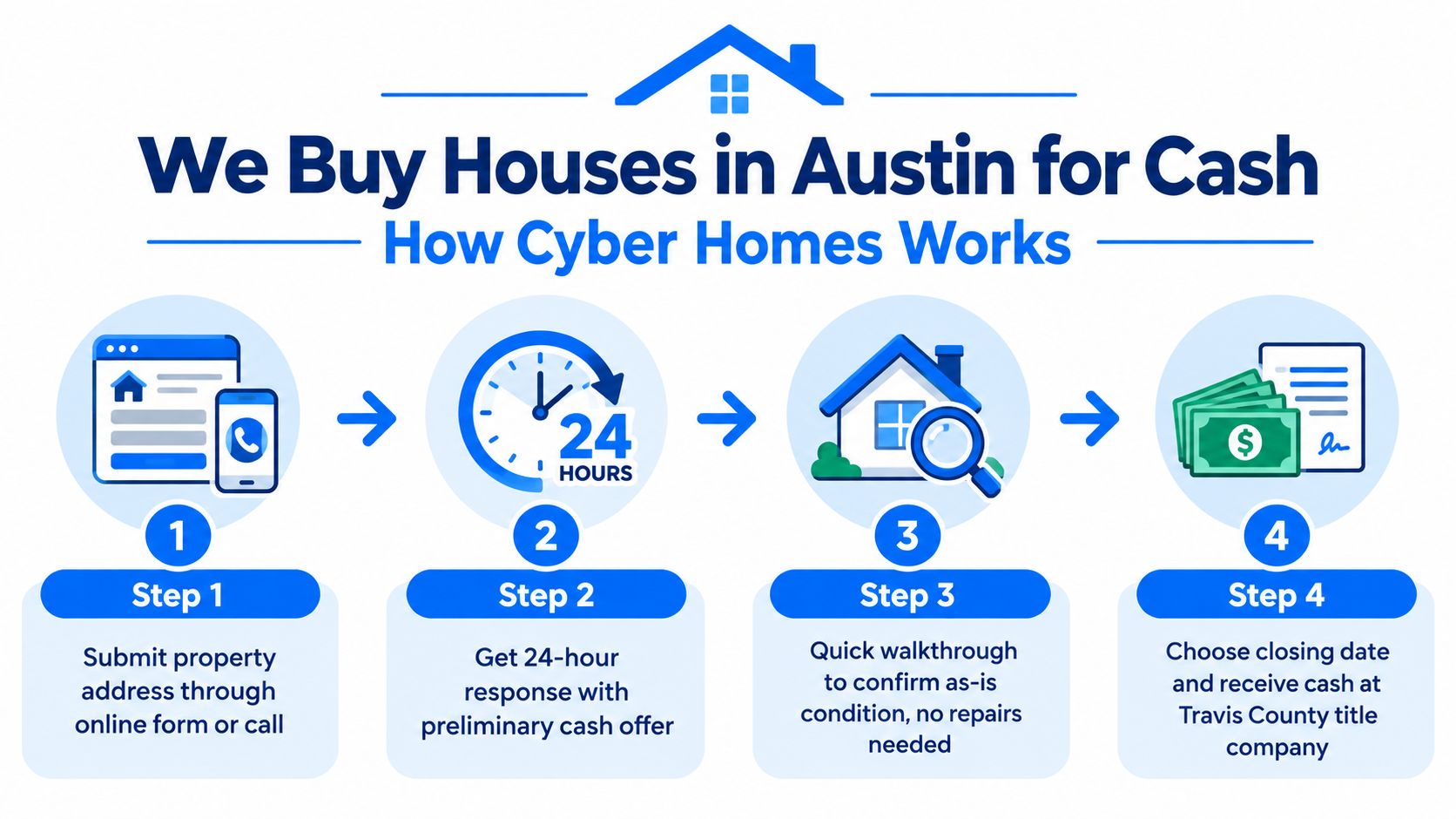
We Buy Houses in Austin for Cash
Cyber Homes' Austin process is straightforward. You submit the property address online or by phone, receive a preliminary response within 24 hours, schedule a walkthrough, review the written offer, choose the closing date, and close through a local Austin title company.
The walkthrough confirms the home's as-is condition. You don't need to make repairs, stage rooms, host showings, or hold an open house. The company can structure a closing around the seller's timeline, with a typical cash window of roughly 7 to 21 days when title is clean.
Austin's older housing stock can bring practical problems, including foundation movement, aging HVAC systems, roof wear, plumbing defects, and deferred exterior maintenance. Those issues matter to an investor's underwriting, but they don't automatically prevent an as-is sale. The same approach can fit a property near major employment centers, a vacant rental, or a home occupied by tenants.
Cyber Homes says it buys properties as-is without commissions and can close through a reputable title company on the seller's preferred timeline. Sellers should still read the contract, confirm who pays each closing charge, verify the earnest-money terms, and ask whether the buyer may assign the contract.
Read how Cyber Homes buys homes for cash before requesting an offer, especially if the property has tenants, probate paperwork, liens, or a foreclosure deadline.
Austin Housing Market Snapshot
An Austin seller in 2026 is choosing between time and certainty. A properly priced MLS listing may produce a stronger gross price, but current market snapshots put exposure around 58 to 78 days. A cash sale trades some price for a defined closing date, which can matter when Travis County taxes, title work, foreclosure deadlines, or probate paperwork are pressing.
Metric Austin or Travis County Value YoY Change Source Austin metro median sale price About $426,220, March 2026 Not provided As noted earlier Austin city median sale price Around $530,000, March 2026 Not provided As noted earlier Austin median sale price $550,000, three months ending August 2026 Down 0.97% Redfin Austin market page Austin median listing price $549,000 Not provided Realtor.com Austin market page Days on market or related timing 58 days city average, 66 days median, 78 days average in separate snapshots Not provided As noted earlier Sold-to-list price 97.89% Not provided As noted earlier Active listings below list 68.3% of sales under list Not provided As noted earlier These figures are not interchangeable. They cover different boundaries, periods, and definitions. Realtor.com reports 66 median days on market, while other Austin snapshots show 58 and 78 days. Use that spread for planning rather than treating one figure as a guaranteed selling timeline.
The market gives buyers more room to negotiate. The resale update reports 50.16% of active listings with price drops and a 97.89% sold-to-list ratio. Redfin reports 68.3% of sales below list. A clean, marketable home can still justify an MLS listing when the owner can wait, handle showings, and absorb carrying costs.
Speed has a specific value in Travis County. A seller facing missed mortgage payments or a foreclosure deadline may need title issues, delinquent taxes, liens, and payoff figures addressed before a closing can proceed. Probate properties may also require court or estate documentation. A cash buyer cannot erase those requirements, but a defined transaction can give the title company and seller a shorter window to resolve them. Cyber Homes' cash process should be evaluated against the offer's discount, contract terms, closing charges, and assignment rights before acceptance.
Austin ZIP Codes That Sell Fastest
No verified ZIP-level dataset was provided for median days on market or median price. A responsible local guide shouldn't fill that gap with guessed figures, especially because several ZIP codes cross market boundaries and some extend toward Williamson County.
The following areas are commonly discussed by Austin sellers, but they can't be ranked in a factual table from the verified data available here:
ZIP Code Neighborhood or area Median Days on Market Median Price 78704 South Lamar and Bouldin Creek Not provided Not provided 78702 East Austin Not provided Not provided 78745 South Austin Not provided Not provided 78758 North Lamar corridor Not provided Not provided 78717 Cedar Park-adjacent area Not provided Not provided A property's ZIP can influence buyer demand, but it doesn't determine a cash offer by itself. An investor underwrites the specific house, its condition, title, occupancy, repair scope, resale potential, and expected holding period. A well-maintained home in a slower pocket may receive stronger interest than a neglected property in a popular one.
Austin's demand base remains broad. The University of Texas at Austin, Dell Medical Center, state government, the capital complex, Ascension Seton, and HCA St. David's support major employment sectors. Tesla and Samsung Austin Campus anchor advanced manufacturing in the eastern Travis and Williamson County corridor, while Oracle's Austin presence and continuing technology activity add further demand.
Population growth and in-migration have supported housing demand, even as Austin works through technology layoffs and a softer resale cycle. That helps explain why homes still sell, but often after longer exposure and with more price negotiation than during the earlier boom. A ZIP-level speed advantage doesn't automatically translate into a higher cash offer because cash buyers price on condition and resale economics, not on the possibility of a multiple-offer event.
What This Means for Austin Sellers
Austin's 2026 market gives sellers a clear choice. Listing on the MLS may produce the highest gross price, but the home can spend roughly 58 to 78 days on the market while the seller pays carrying costs and responds to price pressure. At the same time, distressed-property activity has increased. One Austin MSA report counted 2,625 properties in pre-foreclosure, foreclosure, or bank-owned status as of April 27, 2026, compared with 2,198 in September 2025, a 19.4% increase. The Austin foreclosure report puts that urgency in local context.
A cash sale makes the most sense when your priority is certainty over maximum gross price, the home needs substantial work, or a deadline matters more than market exposure. Foreclosure, probate, divorce, relocation, inherited property, tenant complications, and code-related liens can all make a conventional listing harder to manage. Clean title is still essential. A cash buyer can't bypass unresolved ownership or lien problems because the buyer has funds.
Use this short decision test:
- Timeline: Do you need a firm closing date rather than an open-ended listing?
- Condition: Can you fund repairs, inspections, cleaning, and buyer-requested credits?
- Holding costs: How long can you carry the mortgage, taxes, utilities, insurance, and maintenance?
- Stress tolerance: Are you prepared for showings, negotiations, price reductions, and possible buyer financing failure?
Request a cash offer, build a realistic MLS net sheet, and compare the two numbers line by line. The better choice is the one that solves your actual constraint, not the one with the most attractive headline price.
Cyber Homes offers Austin homeowners an as-is cash-sale option with no repairs, showings, or commissions, followed by a title-company closing on the seller's timeline. If foreclosure, probate, relocation, or a dated property is putting pressure on your decision, visit Cyber Homes to request an offer and compare it with your realistic MLS net.
Edited by
James Vasquez
Real Estate Investor & Land Specialist with 10+ years experience in residential flipping, vacant land investing, land wholesaling, and subdivision deals.
Disclaimer: The information provided is for educational purposes and does not constitute financial or legal advice. Always consult with licensed professionals before making investment decisions.